Free
0$
 Spot scanner
- Every 5th spread unlocked
- Futures scanner as a gift
- Spread chart
- 20+ available exchanges
- Accurate calculation for your balance
- 7 days access
- 30 days access
- Price per day
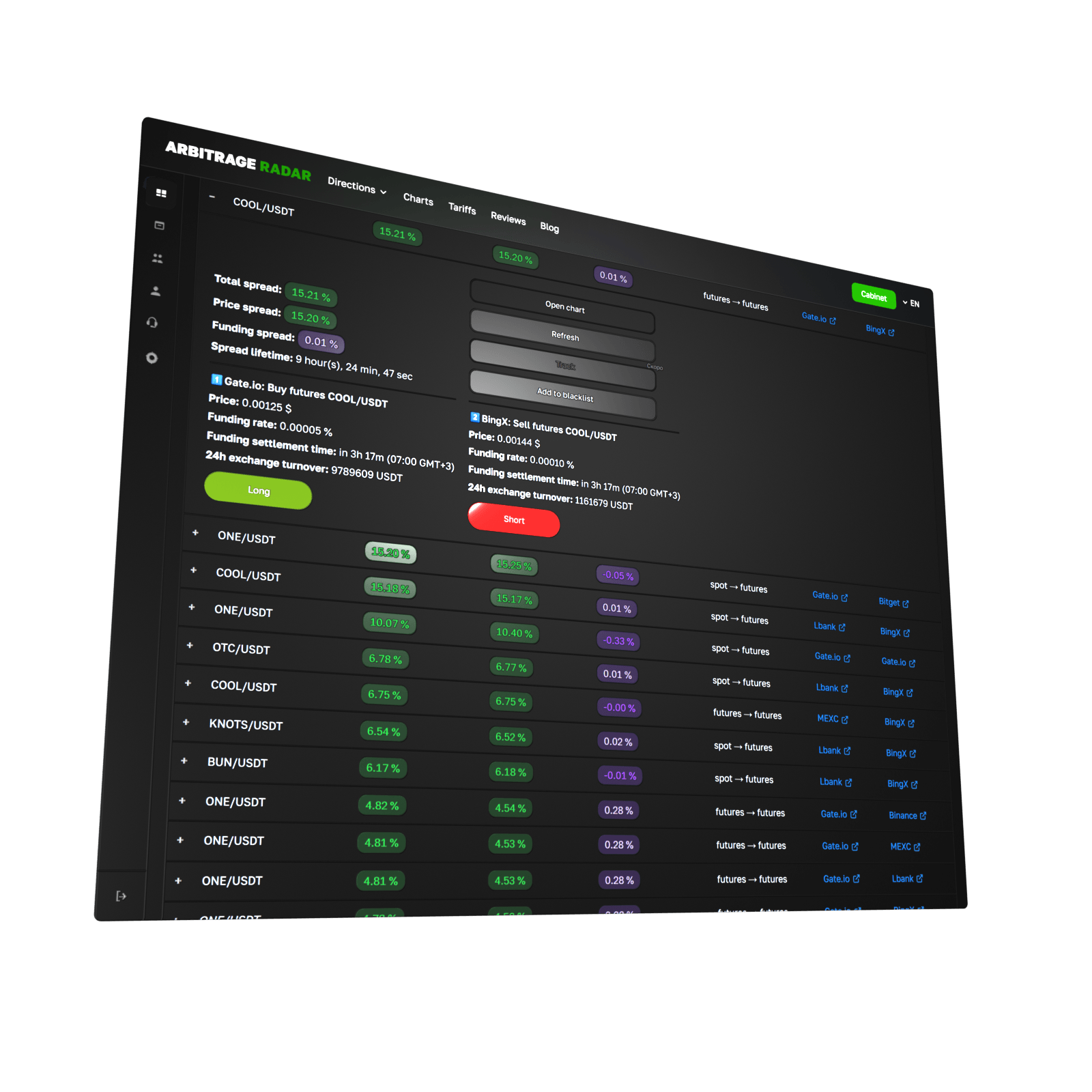


The charts section is your tool for in-depth spread analysis. It allows you not just to monitor the spread in real time, but to see its dynamics compared to past situations. This means that every decision you make is not blind, but based on history and real data.
If you work with futures arbitrage, this tool will become your main assistant. Here you can easily track the recurrence of market scenarios, the speed of spread changes and the reaction of different exchanges — everything that helps build truly profitable strategies.
Intuitive charts turn dry numbers into clear visual hints. You find profitable entry points faster, reduce risks and feel confident in any market situation. With our service, analysis becomes not only effective but also convenient.
0$
32$
59$
69
290$
0$
Spot scannerEvery 5th spread unlocked20+ available exchangesAccurate calculation for your balance32$
Spot scannerAll spreads unlockedSpread chart20+ available exchangesAccurate calculation for your balance7 days access59$
69
Spot scannerAll spreads unlockedFutures scanner as a giftSpread chart20+ available exchangesAccurate calculation for your balance7 days access30 days access290$
Spot scannerAll spreads unlockedSpread chart20+ available exchangesAccurate calculation for your balance7 days access30 days accessArbitrage Radar is a cross-exchange crypto arbitrage scanner. It finds spot, futures and funding-rate spreads across 20+ exchanges, including Binance, Bybit, OKX and Hyperliquid, and shows net profit after trading fees, network withdrawal fees and order-book depth. Spreads are available in a web table on the site and in Telegram bots.
Crypto arbitrage means profiting from price differences of the same asset on different exchanges: you buy a coin where it is cheaper and sell it where it is more expensive. Your profit is the price difference minus trading fees, the transfer fee and slippage.
The fastest way is a scanner: tracking thousands of pairs across dozens of exchanges by hand and calculating fees on the fly is practically impossible. Arbitrage Radar continuously compares quotes, checks deposit and withdrawal availability and shows spreads with profit calculated after all fees. You can use the same scanner in Telegram: a full-featured bot there has the spread list, filters and settings, and it sends new spreads on its own.
Because costs are deducted from the spread: trading fees on the buy and sell, the withdrawal fee in the chosen network, and slippage — the price gets worse as your order eats through several order-book levels. A 3% spread in a thin order book can pay less than 1% in a liquid one. The Arbitrage Radar spot scanner shows profit in dollars after all these deductions, based on order-book depth, and recalculates it for your deposit.
No. Arbitrage Radar is a scanner, not a trading bot: it finds spreads and calculates profit, and you place the trades yourself on the exchanges. You do not need to connect exchange API keys or a wallet, so the service has no access to your funds.
More than 20 exchanges. Spot: Binance, Bybit, OKX, KuCoin, Gate.io, MEXC, HTX, Bitget, BingX, Poloniex, BitMart, Bitfinex, XT, AscendEX, ProBit, CoinEx, CoinW, LBank and WEEX. Futures: Binance, Bybit, KuCoin, Gate.io, MEXC, HTX, Bitget, BingX, BitMart, Bitfinex, AscendEX, CoinEx, LBank, BloFin and Ourbit, plus the decentralized exchanges Hyperliquid and Aster.
Yes. The free plan has no time limit: the table lists all spreads with exchanges and spread %, and every 5th spread is fully unlocked — with the pair, profit, networks and exchange links. On top of that, you get 1 hour of full access after sign-up, no card required.
There is a free plan. Paid plans are weekly, monthly and yearly, separately for the spot and futures scanners, starting at $29 per week. With a monthly plan, the second scanner is included as a gift. See current prices in Tariffs.
For beginners, we recommend starting with the futures scanner: futures arbitrage does not require transferring coins between exchanges, so there are no withdrawal fees or stuck transfers, and there are more opportunities. You only need a deposit on at least two exchanges. Spot arbitrage requires transferring coins between exchanges, but it performs especially well during high volatility, when spreads get bigger. 🎁 With a monthly plan, you get access to both scanners.
It is profiting from the difference in funding rates for the same coin on different exchanges. You open a long where the rate is lower and a short where it is higher: the positions hedge each other against price moves, and the difference in funding payments becomes your income. The Arbitrage Radar futures scanner shows the price spread, the funding spread and their total separately, plus the time of the next payment.
Compare the smart contract addresses: the same ticker sometimes refers to different coins on different exchanges, and such a "spread" with a huge percentage does not actually work. The Arbitrage Radar spot scanner tries to verify contract addresses for every token and marks the spread with a check mark when they match. If a match is not confirmed, check the address on the exchanges' deposit and withdrawal pages before trading. In futures arbitrage, it is easier to open the spread chart: if the prices on both exchanges move the same way and correlate over time, it is the same token.
Opportunities always exist, but many have low liquidity. Large liquid spreads appear more often during sharp market moves, regardless of the trend direction, so traders usually set up filters and notifications and wait for the right conditions. Futures offer more opportunities than spot: besides price differences, you can earn on funding rate differences.
You can start with about $100, but with a small deposit transfer fees matter more, so you will have to stick to cheap networks. Futures arbitrage has no transfer fees, but your deposit has to be split across at least two exchanges. Leverage is available on futures, but only experienced arbitrage traders should use it.
The main risks: an exchange can suspend deposits or withdrawals of a coin, the price can change while the transfer is in progress, the same ticker can hide different tokens, and slippage in a thin order book can eat the spread. Checking contract matches, choosing fast networks, recalculating the spread for your volume and keeping trade size moderate all reduce these risks.
No. The scanner shows the estimated profit at the moment a spread is found, but prices, order books and deposit/withdrawal status can change before you trade. Refresh the order book in the spread card and check the conditions on the exchanges before trading.
Arbitrage Radar runs full-featured Telegram bots — separate ones for the spot and futures scanners — with the spread list, filters and settings. Once notifications are enabled in the bot settings, the bot sends new spreads matching your filters on its own, and on the site you get browser notifications when table auto-update is on. Data updates in real time, so you learn about a spread right after it appears. Notifications are available on paid plans.
Involves physically buying a token, transferring it to another exchange, and then selling it.
This approach is based on the price difference between two futures contracts or between spot and futures. It does not involve transfers. Opposite trades are opened at the same time on different exchanges.
One type of arbitrage in futures markets. Built on the difference in funding rates between two exchanges. It can work alongside futures price arbitrage or independently of it.
This type of arbitrage also works with spot assets, but one or more of the exchanges used are decentralized (DEX).